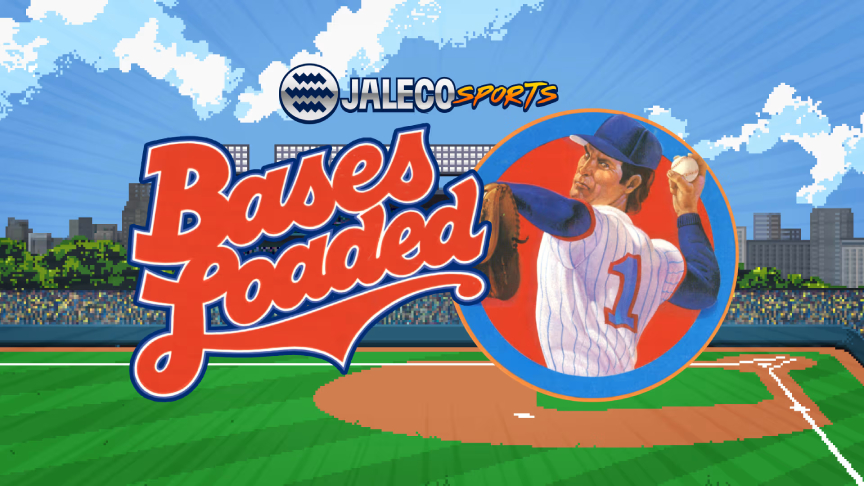
Jaleco Sports: Bases Loaded revives two retro baseball simulators of yesteryear thanks to the efforts of Rock It Games. Bundling Bases Loaded (NES, 1988) and Super Bases Loaded (SNES, 1992), despite my nostalgia, I am glad to see these old games receive new life on modern consoles. Even though these are two titles that I appreciate, respect, and admire, they are tough to enjoy in the modern era.
Originally developed by Tose and published by Jaleco, the original Bases Loaded was a standout title thanks to its realistic (for the time) presentation. Personally, I was five years old when this game was released and remember watching my brother, who is about five years older than me, play it. Even though I barely understood baseball at the time, I remember being enthralled watching these pixelated characters simulate an MLB match. From the subtle, low-tone music, to hearing the shockingly clear (again, for the time) voice quips, to the expressions of excitement and disappointment in the sprite design, there was something magical about it. As I replayed it now in my old age, I was transported back to the late 80s and brought a smile to my face as I was taken back to my childhood.
While I enjoyed watching my brother play it back in the day, I sadly do not enjoy playing Bases Loaded today. In short, the game is painfully slow. For example, you need to wait for the catcher to throw the ball back to the pitcher after each pitch. There is a brief cutscene of the batter walking back to the dugout after a strike out. The presentation constantly cuts back to shots of the scoreboard and player roster. At the time, this realistic presentation was one of the highlights of playing this game. Today, it drags the game to a crawl, making each moment a painful slog.
The isometric viewpoint of the pitching/batting segment is also weird at best as every pitch is essentially a strike. I didn’t realize this back in the 80s but the pitching/batting is much more based on verticality as opposed to aligning shots horizontally. The problem with this means that every pitch looks like a strike despite the speed or positioning. Unless you specifically move all the way over and want to throw an intentional ball, most pitches register as strikes even if they are positioned outside. In short, the isometric perspective looks cool but doesn’t perform well in practice.
Super Bases Loaded is easily the much better and more playable game. Just about everything that dragged the original has been improved with this 16-bit sequel. The gameplay is faster and more polished. However, the isometric perspective remains and gets more confusing though. When a ball is hit, the perspective changes to a reverse outfield angle. Meaning, it is as if you are controlling the game from the outfielder looking towards the bases as opposed to the standard infield outward. Putting it simply, it is super weird having first base be on the left and home plate designated as Up on the d-pad. There is also the awkward moment of confusion when the game doesn’t know if you want to control an infielder or an outfielder when the ball exits the infield. Further, the entire point of Super Bases Loaded isn’t simply about winning; it is about playing a perfect game. The game is secretly tracking the player’s performance at all times and provides a score accordingly. Unfortunately, with the goofy perspective and finicky gameplay, achieving this feat is nearly impossible. So even though SBL is better than the original, it isn’t without its blemishes.
Regardless of their quality, these games are wrapped around a surprisingly nice user interface complete with original graphics and soundtrack. Also, if you dig through the menu, you can find instruction manual scans and a high quality, rotatable, full 3D recreation of the box art. The SBL box is especially interesting because all the imperfections are retained in the 3D version, right down to faded cracks in the creases. It is a nice touch because this doesn’t need to be in the game, and doesn’t necessarily enhance the overall gameplay, but it is something fans will appreciate for documentation’s sake. Also, the game automatically saves upon quitting then asks if you want to continue or start a new game when reloading, which is a streamlined feature.
Being honest, these Bases Loaded games don’t hold up well but still glad they are given new life on a modern console; this is coming from both my personal nostalgia and as a game preservation perspective. At the same time, I need to ask the question – why weren’t the other games included? There were three other Bases Loaded titles on NES, a few on SNES, and even a Gameboy release. So why not put all of them on one compilation? (I am guessing player/team likenesses are the issue?) Further, the My Arcade handheld not only included all NES Bases Loaded titles, it also included Racket Attack and Hoops. These two games probably could have been on the Switch Online NES and SNES apps but was probably held back for this $7.99 compilation price. At the same time, I can’t really see anyone being interested in Bases Loaded by anyone younger than 40 years of age. Still, it is cool that it is here even though playing it could ruin your childhood memories because you thought these games were the best back in the day.
SCORE: 5/10
Not As Good As: you remember
Also Play: Baseball Stars
Wait For It: an R.B.I. compilation
By: Zachary Gasiorowski, Editor in Chief myGamer.com
X/Twitter: @ZackGaz
Please consider supporting me on Patreon or BuyMeACoffee.


0